
XOVR VC Lens: The Proprietary Entrepreneur Factor® Framework
A Venture Capital ETF Approach to Public and Private Company Investing
XOVR applies a venture capital-style research framework to both public and private markets, powered by ERShares’ proprietary Entrepreneur Factor®.
The XOVR VC Lens is ERShares’ proprietary investment framework for evaluating public and private companies, including pre-IPO private companies such as SpaceX, through a research perspective inspired by long-horizon venture capital investors. Its core model, the Entrepreneur Factor®, integrates 18 proprietary qualitative and quantitative attributes across leadership, governance, culture, innovation, category formation, competitive moats, growth persistence, capital efficiency, financial quality, valuation, and risk. The framework seeks to identify exceptional businesses before their category leadership is fully reflected in market consensus. In short, the VC Lens is how XOVR evaluates venture capital-style investment opportunities across both public markets and private markets.
XOVR generally maintains approximately 85% of its portfolio in public equities selected primarily from the ER30TR Index universe, with up to approximately 15% allocated to select private-company investments, such as SpaceX and Kalshi, giving everyday investors indirect pre-IPO exposure. The fund is actively managed; the ER30TR methodology serves as its public-market backbone rather than a mechanically replicated benchmark. As a Nasdaq-listed ETF, XOVR allows investors to access private-market exposure through a standard brokerage account.
The process is designed to identify category leaders during earlier stages of their development, underwrite them across multiple dimensions, and remain invested while the long-term compounding thesis remains intact. This approach positions XOVR as an ETF that seeks to provide exposure to publicly traded companies and select private-company investments.
THE INTELLECTUAL FOUNDATION
From Venture-Capital Research to a Proprietary Public-Market Model
After decades of academic and applied research, Joel M. Shulman, PhD, CFA, developed a methodology for studying how successful venture capital investors identify, evaluate, and retain exposure to outlier companies. The research focused on the organizational, strategic, and financial characteristics that can distinguish a future category leader before its economic potential becomes broadly recognized.
Venture-capital research
Decades of academic and applied research into how successful venture investors identify outlier companies.
ER30TR Index
The systematic public-market expression of the Entrepreneur Factor®.
XOVR private sleeve
The same proprietary logic extended to select private companies.
The resulting Entrepreneur Factor® converts elements of venture capital judgment into a codified, repeatable research system. Rather than relying on a single style factor or a narrow valuation screen, the model seeks to measure entrepreneurial quality as a multi-dimensional construct: the interaction among leadership, culture, innovation velocity, market structure, competitive durability, capital allocation, and financial scalability; a systematic alternative to traditional venture capital investing.
ERShares then translated that proprietary framework into the public markets through the ER30TR Index and now applies the same underlying logic to select large private companies— including pre-IPO companies like SpaceX and Kalshi — through XOVR. The factor definitions, scoring architecture, weights, interaction effects, thresholds, and portfolio-construction rules remain proprietary to ERShares.
From venture capital research to the first private-public crossover ETF
Decades of research into how successful venture capital investors identify exceptional companies before they become widely recognized.
The same leadership, culture, innovation, competitive and capital-allocation characteristics continue to influence outcomes after a company lists. That insight became the ER30TR Index, the systematic public-market expression of the Entrepreneur Factor®, which identified the companies now known as the Magnificent Seven during earlier phases of their development, including Nvidia beginning in 2005 at roughly $5 split-adjusted.
up to ~15% private
Applying the same lens before the listing was a progression, not a departure. Roughly 85% of the portfolio generally consists of public equities selected primarily from the ER30TR universe, while up to approximately 15% may be allocated to private companies that meet the fund’s underwriting, valuation, liquidity and portfolio-fit standards.
ERShares believes XOVR was the first* ETF designed to combine a venture-capital-inspired public-equity framework with carefully selected private-company exposure inside a single, publicly traded fund: one integrated research system across both public and private companies.
THE MODEL
The Entrepreneur Factor®: An Integrated Research Framework for Category Leadership
The Entrepreneur Factor® conceptualizes entrepreneurial quality as a latent, multi-dimensional construct rather than a single observable metric. It evaluates 18 proprietary qualitative and quantitative attributes with attention to cross-domain interaction effects, longitudinal persistence, signal quality, and the conversion of strategic advantage into durable economic output. The objective is to identify companies whose leadership, organizational systems, and financial architecture may support persistent innovation and long-duration value creation.
Founder and leadership architecture
Does senior leadership exhibit founder-like ownership, strategic time-horizon discipline, calibrated risk tolerance, capital-allocation, skill, and the cognitive flexibility required to navigate technological or market discontinuities?
Governance and incentive alignment
Do board structure, executive incentives, ownership concentration, and decision rights align management behavior with long-duration value creation rather than short-term accounting optimization?
Organizational culture and human-capital density
Does the organization compound talent, preserve mission coherence, reward intelligent experimentation, and maintain a sufficiently high density of technical, commercial and operational capability?
Decision velocity and institutional learning
Can the company shorten feedback loops, absorb disconfirming evidence, reallocate resources rapidly, and convert organizational learning into superior execution without creating control-system fragility?
Category formation and market topology
Is the company merely competing within an established market, or is it reshaping customer behavior, technical standards, distribution architecture, and the economic boundaries of an emerging category?
Product-market fit and adoption diffusion
Do retention, engagement, cohort behavior, use-case expansion, and adoption curves indicate durable utility and a credible pathway from early adoption to broader market penetration?
Innovation persistence and R&D productivity
Is innovation generated by a repeatable research, product-development, and commercialization system, and does incremental R&D spending produce defensible intellectual, technical or economic output?
Moat topology and competitive game dynamics
Are competitive advantages reinforced through network effects, switching costs, scale economies, proprietary data, intellectual property, regulatory complexity, distribution control, or ecosystem dependence—and how may competitors rationally respond?
Distribution control and ecosystem leverage
Does the company control scarce customer access, critical workflow integration, platform standards, or partner economics that can reduce acquisition friction and increase strategic bargaining power?
Growth persistence and market-share migration
Are revenue growth and share gains supported by structural demand, repeat-purchase, behavior and reinvestment capacity, or are they dependent on temporary pricing, cyclical conditions, or unsustainably high customer acquisition?
Revenue architecture and unit economics
Do pricing power, gross-margin structure, contribution economics, customer-acquisition efficiency, lifetime value, retention, and incremental margins support scalable value creation?
Capital efficiency and reinvestment runway
Can the company redeploy incremental capital at attractive returns, and is the addressable reinvestment opportunity sufficiently large to sustain compounding without degrading return on invested capital?
Earnings quality and cash-flow realization
Do accrual quality, working-capital behavior, stock-based compensation, free-cash-flow conversion, and operating leverage corroborate the underlying economic thesis?
Balance-sheet resilience and financing optionality
Does the capital structure preserve strategic flexibility under adverse scenarios, and can the company fund growth without introducing unacceptable dilution, refinancing risk, or liquidity dependence?
Valuation duration and scenario-weighted asymmetry
Does a probability-weighted range of outcomes justify the entry valuation after considering growth duration, terminal economics, discount-rate sensitivity, dilution, execution risk, and downside severity?
Risk decomposition and regime sensitivity
How exposed is the thesis to factor rotations, interest rates, regulation, geopolitical shocks, technological substitution, concentration, correlation, and changes in market liquidity?
Information quality and confidence weighting
How reliable, timely, and decision-useful are the available data, and how should conflicting qualitative and quantitative evidence affect thesis confidence and position sizing?
Portfolio fit, liquidity and lifecycle pathways
How does the position affect portfolio concentration, covariance, liquidity, valuation risk, and potential exit pathways across public listings, secondary transactions, acquisitions, recapitalizations, or continued private ownership?
ADVANCED ANALYTICAL ARCHITECTURE
An Integrated Multi-Stage Investment Framework
The VC Lens is not intended to function as a simple checklist or a conventional factor screen. It treats entrepreneurial quality as an interconnected system in which leadership, culture, innovation, market structure, and financial economics can reinforce—or invalidate—one another. A company may score strongly in one domain yet fail the broader underwriting test when the interaction among domains is considered.
Signal acquisition and evidence triangulation
The research process integrates qualitative evidence with quantitative operating data, cross-sectional peer comparisons, and longitudinal company histories. The objective is to separate high-signal indicators of durable advantage from narrative momentum, cyclical noise, and temporary accounting effects.
Interaction effects and causal-chain validation
Variables are evaluated in combination rather in isolation. Leadership quality must translate into resource allocation; innovation must translate into adoption; adoption must translate into defensible unit economics; and unit economics must translate into cash-flow capacity and reinvestment optionality. Breaks in that causal chain can weaken the investment thesis even when headline growth remains strong.
Scenario analysis and probabilistic underwriting
The framework considers multiple operating and valuation pathways rather than relying on a single-point forecast. Base, upside, and downside cases may be examined through growth duration, incremental margins, capital intensity, dilution, terminal economics, discount-rate sensitivity, and liquidity constraints to assess the distribution of potential outcomes.
Longitudinal thesis updating
Thesis confidence is updated as new evidence emerges, in a process analogous to Bayesian learning. The focus is not on whether a security price moved in the short term, but whether the causal drivers of category leadership, competitive durability, financial scalability, and valuation asymmetry have strengthened or deteriorated.
The analytical domains below are illustrative groupings and do not map one-for-one to the 18 proprietary attributes. The exact variables, source hierarchy, data transformations, normalization conventions, weights, interaction rules, decision thresholds and portfolio-implementation logic are not publicly disclosed.
THE INVESTMENT PROCESS
A Four-Layer Underwriting and Thesis-Validation Architecture
Entrepreneurial-quality signal identification
The process first identifies companies exhibiting a statistically and qualitatively unusual configuration of leadership, culture, category formation, innovation persistence, and competitive durability. The objective is to detect emerging category leaders before those attributes are fully capitalized into market consensus.
Cross-domain fundamental and quantitative validation
Qualitative conviction is triangulated against observable operating evidence, including cohort behavior, revenue quality, unit economics, incremental margins, capital efficiency, free-cash-flow conversion, balance-sheet resilience, and valuation. This stage seeks to distinguish economically scalable systems from compelling but non-monetizing narratives.
Scenario-weighted valuation and risk decomposition
The investment is evaluated across multiple operating and valuation scenarios, including sensitivity to growth duration, margin realization, capital intensity, dilution, discount rates, competitive response, and liquidity. The objective is to understand the asymmetry, path dependency and downside topology of the prospective return distribution.
Longitudinal thesis updating and portfolio integration
Positions are monitored against the causal architecture of the original thesis, not short-term price movements alone. ERShares evaluates changes in competitive structure, management execution, innovation cadence, financial quality, valuation, correlation, concentration, and liquidity to determine whether a holding continues to merit capital within the broader XOVR portfolio.
Identify early. Underwrite deeply. Hold through compounding.
ERShares seeks to identify category leaders before they become consensus holdings and to retain them over long periods while leadership quality, competitive advantage, reinvestment opportunity, and valuation continue to support the investment thesis. The objective is not frequent prediction; it is long-duration participation in exceptional businesses. This long-term, venture capital-style holding period is a key differentiator for XOVR ETF investors seeking pre-IPO and public growth exposure in one fund.
HISTORICAL APPLICATION
The VC Lens Applied to the Magnificent Seven
The framework self-reportedly identified each of the companies now known as the “Magnificent Seven” – Nvidia, Apple, Amazon, Alphabet, Meta, Microsoft, and Tesla – during earlier phases of their public-market development. ERShares began identifying Nvidia in 2005, when its split-adjusted share price was approximately $5, and maintained a research orientation focused on the company’s innovation trajectory, leadership, and category-defining potential rather than short-term market narratives. This track record of early identification is a core reason investors compare XOVR to other venture capital ETFs and growth-focused funds.
The significance is not hindsight recognition of successful stocks. The significance is the process.
Recognize the underlying characteristics of emerging category leaders before their scale, market dominance and index significance are fully visible to the broader market.
Continue evaluating the thesis through multiple product cycles, competitive challenges and market drawdowns rather than short-term market narratives.
Identifying a company early creates value only when the process supports disciplined long-term ownership. The VC Lens emphasizes both.
XOVR extends the same proprietary framework across the company lifecycle. The public portfolio seeks entrepreneurial category leaders through the ER30TR methodology, while the private sleeve allows the research team to evaluate select companies before they enter the public markets, such as SpaceX, giving XOVR shareholders indirect pre-IPO investment exposure without accredited-investor requirements.
The inclusion of these companies is presented as a historical illustration of the framework’s application and should not be interpreted as evidence that future investments will achieve similar results.
THE PUBLIC-MARKET EXPRESSION
ER30TR: The Entrepreneur Factor® Applied Systematically to Public Equities
The ER30TR – ERShares 30 Total Return Index is the rules-based public-market expression of the Entrepreneur Factor®. It applies the proprietary 18-attribute framework to a primarily U.S. large-cap universe and selects 30 companies that exceed the methodology’s entrepreneurial-quality threshold.
Research foundation
Academic and industry research behind the model.
Attribute architecture
The proprietary Entrepreneur Factor® construct.
Entrepreneurial category leaders
With the potential for durable long-term growth.
Rebalance cadence
Systematic selection on a scheduled cycle.
Role inside XOVR
Share of the portfolio drawn from this universe.
XOVR is actively managed and does not replicate the ER30TR Index position-for-position. Instead, ER30TR functions as the fund’s public-equity research backbone, providing a disciplined universe of companies that satisfy the proprietary Entrepreneur Factor® threshold.
LONG-TERM PERFORMANCE CONTEXT
ER30TR Performance Across Multiple Market Cycles
The chart below covers June 30, 2005, through March 31, 2026. Over the full period shown, the ER30TR Index outperformed each benchmark displayed on both a cumulative and annualized basis, including the Nasdaq-100, Russell 1000 Growth, S&P 500, and Dow Jones Industrial Average. This long-horizon comparison illustrates the historical outcome of applying the Entrepreneur Factor® across multiple market regimes; it does not represent XOVR performance and does not guarantee future results.
the same period
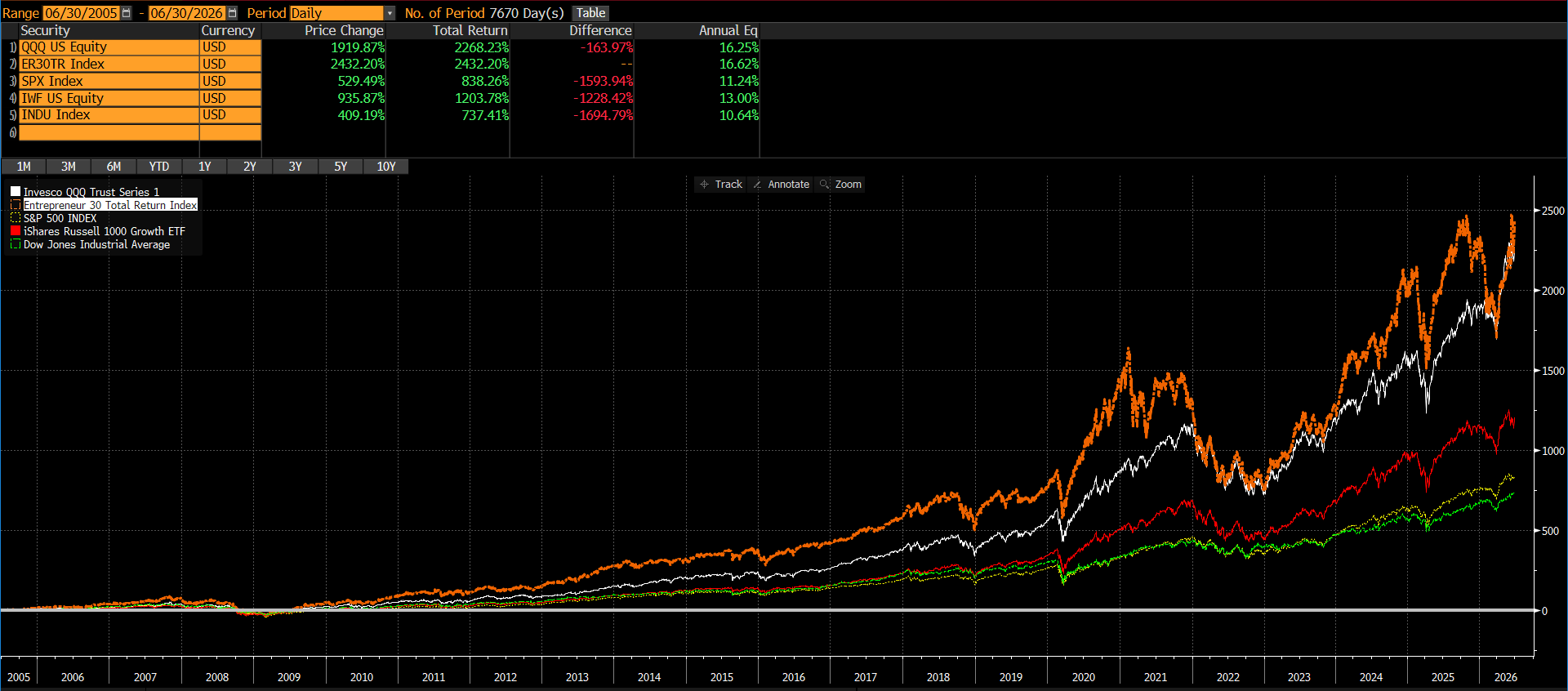
ER30TR Index performance comparison, June 30, 2005-March 31, 2026. Source: Bloomberg performance image supplied by ERShares.
Performance shown is for the index/composite comparison presented in the supplied Bloomberg chart, not XOVR. Index performance does not reflect fund fees, expenses, trading costs, or the current private-public crossover implementation. Past performance does not guarantee future results.
Different market environments may produce different relative results. Cannot invest directly in an index.
EXTENDING THE MODEL INTO PRIVATE MARKETS
The Same Proprietary Lens, Applied Before the Public Listing
The private-company sleeve of XOVR is a natural extension of the Entrepreneur Factor®. Where public-market analysis can rely on standardized filings and continuous price discovery, private-company underwriting requires a more transaction-specific assessment of management, market structure, competitive advantage, scalability, financing terms, valuation, liquidity, and potential exit pathways. This is where XOVR functions as a pre-IPO ETF, extending venture capital-style due diligence to private company investments.
The framework informed XOVR’s original private investment in SpaceX, one of the most discussed pre-IPO companies among retail investors, and its recent investment exposure to Kalshi. In each case, the research question was not simply whether the company was prominent or difficult to access. The question was whether the company exhibited the leadership architecture, category-defining potential, innovation persistence, competitive durability, and long-term economic opportunity required by the proprietary VC Lens.
ER30TR research universe
Standardized financial and market data
Systematic quarterly index process
Public price discovery
Entrepreneur Factor® threshold
Selective, transaction-driven private-company opportunities
Company-specific information, financing terms and private valuation evidence
Active underwriting, sizing, valuation and liquidity management
Fair-value process under applicable fund valuation policies
The same core qualitative and quantitative investment logic, adapted to private-market information
Crossover Era
One framework, both sides of the market
XOVR combines private-company exposure to select companies that are not broadly available in public markets with public equities selected through ERShares' VC lens and Entrepreneur Factor® framework. The result is a single strategy built around identifying category creators across both sides of the market.
THE XOVR PORTFOLIO ARCHITECTURE
A Private-Public Crossover Built Around One Research System
XOVR is designed to provide continuity across the company lifecycle: public entrepreneurial leaders selected through the ER30TR framework, combined with a measured allocation to select private companies evaluated through the same VC Lens. This makes XOVR one of the few ETFs offering combined public and private equity exposure in a single Nasdaq-listed fund.
FREQUENTLY ASKED QUESTIONS
XOVR VC Lens and Entrepreneur Factor® FAQ
What is the XOVR VC Lens?
The XOVR VC Lens is ERShares’ proprietary approach to evaluating public and private companies like a long-horizon venture capital investor. It combines qualitative underwriting with quantitative validation through the Entrepreneur Factor®. It is the research process behind XOVR’s positioning as a venture capital ETF with both public-equity and pre-IPO private-company exposure.
What is the Entrepreneur Factor®?
The Entrepreneur Factor® is ERShares’ proprietary model for evaluating entrepreneurial quality across 18 qualitative and quantitative attributes, including leadership, culture, innovation, category leadership, competitive moats, growth, capital efficiency, valuation, and risk.
Who developed the Entrepreneur Factor®?
Joel M. Shulman, PhD, CFA, developed the methodology after decades of academic and applied research into entrepreneurship, venture capital, and long-term company performance.
How does XOVR invest like a venture capital investor?
XOVR applies a venture capital-style framework that seeks to identify category leaders early, underwrite leadership, governance, culture, and market structure deeply, validate the thesis through operating and financial evidence, and maintain a long-term investment horizon while the causal drivers of the thesis remain intact.
Did the VC Lens identify the Magnificent Seven early?
ERShares states that the framework identified each of the companies now known as the “Magnificent Seven” during earlier phases of their public-market development. Nvidia was identified beginning in 2005 at an approximately $5 (split-adjusted) share price. Historical identification does not guarantee future results.
How is the ER30TR Index connected to XOVR?
The ER30TR Index is the rules-based public-market expression of the Entrepreneur Factor® and serves as XOVR’s public-equity backbone. Approximately 85% of XOVR is generally allocated to public equities, primarily selected from the ER30TR universe.
Does XOVR track the ER30TR Index exactly?
No. XOVR is actively managed. It uses ER30TR as the primary public-equity research universe while retaining flexibility in portfolio construction and allocating up to approximately 15% to private-company investments.
How did the framework inform the SpaceX and Kalshi investments?
The same VC Lens used to assess public category leaders informed XOVR’s original private investment in SpaceX and its exposure to Kalshi, with an emphasis on leadership, category formation, innovation, moat durability, scalability, valuation and portfolio fit. This is a key reason individual investors seek to invest in SpaceX through a publicly traded ETF.
Is the Entrepreneur Factor® proprietary?
Yes, it is. The 18 attributes, factor definitions, weights, interaction effects, scoring thresholds, and portfolio rules are proprietary to ERShares.
Why was XOVR’s private-equity strategy a natural extension of the VC Lens?
The Entrepreneur Factor® originated in research into how successful venture capital investors identify and evaluate exceptional companies. ER30TR brought that research framework into public equities, and XOVR extends the same proprietary logic back into select private companies. ERShares believes XOVR was the first* ETF designed to combine this venture capital-inspired public-equity framework with carefully selected private-company exposure in one publicly traded fund, commonly searched as a “private-public crossover ETF” or “venture capital ETF for individual investors”.
Why is the Entrepreneur Factor® difficult to replicate?
The framework is not reducible to a public checklist. Only broad analytical domains are described publicly. The exact factor definitions, source hierarchy, normalization procedures, confidence-weighting conventions, interaction logic, decision thresholds, monitoring rules, and portfolio-construction constraints remain proprietary to ERShares.
The inclusion of these companies is presented as a historical illustration of the framework’s application and should not be interpreted as evidence that future investments will achieve similar results.
Invest Across the Company Lifecycle With XOVR
XOVR combines a public-equity portfolio informed by the proprietary ER30TR and Entrepreneur Factor® methodology with selective private-company exposure inside one Nasdaq-listed ETF, offering investors a way to access SpaceX exposure and other pre-IPO companies through a standard brokerage account. Review current holdings, fees, risks, and the prospectus before investing.
Important Risk Information
Investing involves risk, including possible loss of principal. XOVR is non-diversified and may be more volatile than diversified funds. Private-company exposure involves additional risks, including valuation uncertainty, limited liquidity, lack of publicly available information, and the possibility that private-company valuations may differ materially from future market prices. XOVR does not directly hold publicly traded SpaceX shares, as SpaceX is not publicly traded. Exposure is obtained indirectly through private-market structures, including SPVs. Holdings are subject to change. ETFs may trade at a premium or discount to NAV. This material is for informational purposes only and is not investment advice or a recommendation to buy or sell any security. Please read the prospectus carefully before investing.
The fund’s investment objectives, risks, charges and expenses must be considered carefully before investing. The prospectus contains this and other important information about the investment company, and it may be obtained by calling +1 (617) 279 0045 or by visiting our website www.ershares.com. Read it carefully before investing. Distributed by Foreside Financial Services, LLC.
Fund Risks can include and are not limited to: Absence of Prior Active Market Risk, Management Risk, New ETF Provider, Common Stock Risk, Market Risk, Concentration Risk, American Depositary Receipts, Early Closing Risk, Exchange Trade Fund Risk, Private Equity Investment Risk, Illiquidity Risk, Valuation Risk, Exit Strategy Risk.
Private equity refers to investments in privately held companies or public companies taken private, typically through pooled funds managed by private equity firms. These firms raise capital from institutional and accredited investors to identify, acquire, and actively manage portfolio companies, aiming to enhance their value over time. After strategic improvements, the fund seeks to exit these investments through sales, mergers, or public offerings. The goal is to generate high returns for investors, albeit with associated risks such as illiquidity and valuation challenges.
The fund does not directly hold shares of SpaceX. Exposure to SpaceX is sought indirectly through investment in SPV Exposure to SpaceX LLC or other special purpose vehicles (“SPVs”) the objective(s) of which is to seek such exposure through investment in privately-offered securities including other private funds (“private securities”) that have exposure to direct interests in SpaceX. The fund may not be able to influence the SPV’s management, and the SPV may hold material amounts of cash while seeking investments. There cannot be any guarantee the SPV will be successful. Private securities are not registered under the Securities Act of 1933 and SPVs are not registered under the Investment Company Act of 1940 and therefore the fund does not benefit from the regulatory protections of those acts when participating in such investments. The SPV and private securities generally may be difficult to value and to sell because of regulatory restrictions on resale. SPVs and private securities may carry additional costs such as transaction fees, operating expenses, management and/or performance fees, capital gains taxes, and brokerage charges. These costs can materially impact both the price paid for the investment and the net returns, if any, generated.
As of February, 9, 2026, the Fund completed a one-time net asset value (“NAV”) adjustment in connection with the conversion of certain legacy private-asset arrangements into a simplified structure aligned on an effective “0/0” economic basis. The adjustment reflects accounting treatment related to prior structuring considerations and does not represent a change in the operating performance or fundamentals of the underlying portfolio companies, nor should it be interpreted as an indication of future portfolio performance.
Please see the following link for top ten holdings and weights in XOVR.
This structural conversion reflects the Adviser’s ongoing evaluation of portfolio construction, vehicle design, and valuation processes, with the objective of promoting transparency, operational clarity, and consistency in financial reporting. The updated structure is intended to support a valuation framework that permits the Fund to incorporate observable market reference points in an operationally efficient manner when such data becomes available.
Investors should not interpret this enhancement as a guarantee of valuation precision, immediacy, or reduced volatility. The valuation of private investments involves significant judgment and is subject to uncertainty. Reported values may differ materially from the prices that could be obtained in an actual transaction, and such differences may be adverse.
All private investments are valued pursuant to the Fund’s established valuation policies and procedures, including oversight through the Adviser’s valuation governance framework and in accordance with applicable accounting standards. The Fund and its service providers apply methodologies believed to be reasonable under the circumstances; however, there can be no assurance that the values assigned will reflect realizable outcomes.
For purposes of this disclosure, “0/0” refers to the removal of legacy private-asset management fee and performance carry economics at the vehicle level. Investors should not interpret this structure to mean that the Fund’s private investments are free of expenses. The Fund will continue to bear its ordinary operating expenses and other costs.
In addition to ordinary operating expenses, the Fund may bear direct and indirect costs associated with private investments, whether incurred at the Fund level, SPV level, underlying fund level, transaction level, or through other investment-related structures, regardless of whether such costs are known at the time of investment.
While the Fund may incur some or all of the expenses described above, such costs may be de minimis relative to the overall size of the Fund’s portfolio at a given time and are generally associated with customary and non-discretionary activities necessary to support private investments, including but not limited to mandatory audits, financial statement preparation, account maintenance, investor reporting, tax documentation, regulatory compliance, and similar administrative functions. Expense levels may vary over time and could increase depending on transaction activity, regulatory developments, structural changes, or other investment-related factors. No assurance can be given regarding the magnitude or duration of such expenses. The Adviser seeks to structure private investments in a cost-efficient manner when practicable; however, there can be no guarantee that such efforts will be successful in all cases.
Private holdings are valued in accordance with ASC 820, and are typically based on valuations reported by funds and the most recent available observable inputs. This methodology is intended to promote financial-reporting consistency and may differ from prices observed in private secondary-market transactions, which may occur at higher or lower valuations. Such differences could be material. There can be no assurance that the Fund’s valuation methodology will reflect the price at which the Fund could exit a position in a current transaction.
Because a meaningful portion of the Fund’s net assets may be invested in private securities valued using methodologies that incorporate significant judgment, changes in reference prices, valuation inputs, or market conditions could result in material adjustments to the Fund’s NAV, including on a short-term basis. Such adjustments may be positive or negative and may occur without corresponding movements in public markets.
The Fund expects to maintain additional net assets in cash or cash equivalents in the SpaceX SPV to support portfolio liquidity, facilitate opportunistic investments, satisfy redemption activity, fund potential capital calls, and meet operating expenses and other obligations. There is no assurance that such capital will be deployed or that any investments will achieve their intended objectives. Maintaining cash positions may, at times, create a temporary performance drag during periods when such assets are not invested; however, the Adviser believes such flexibility supports prudent portfolio management. The Fund’s cash allocation is established within the Adviser’s liquidity risk management framework and is designed to preserve operational flexibility while supporting compliance with applicable regulatory expectations and maintaining prudent portfolio construction. The Fund’s cash allocation may vary from these levels based on market conditions, transaction timing, and portfolio management considerations.
The Fund manages liquidity as part of a comprehensive risk management framework designed to support its ability to meet shareholder redemptions and other obligations under a range of market conditions, including periods of market stress. The Adviser evaluates liquidity across the portfolio on an ongoing basis using multiple factors that may include market depth, anticipated transaction timelines, structural characteristics of private investments, and potential capital needs.
The Fund seeks to maintain sufficient flexibility through portfolio construction, cash management, and access to liquidity sources; however, there can be no assurance that these efforts will be successful in all market environments. Private investments are generally less liquid than publicly traded securities and may require extended time frames to exit or monetize. In certain circumstances, the Fund may need to adjust portfolio exposures, delay investment activity, or take other actions it considers appropriate in order to manage liquidity.
As a result of the size of this position relative to the Fund’s portfolio, changes in the assigned valuation of this investment could have a proportionally greater impact on the Fund’s NAV than the valuation changes of smaller positions.
For more information related to the risks of the fund, please refer to the prospectus. The prospectus can be obtained by calling 1-833-368-7383 and be viewed at https://entrepreneurshares.com/.
ERShares is distributed by Foreside Financial Services, LLC. There is no affiliation between ERShares and Foreside Financial Services distributors.
*Basis of “first” claim: ERShares review of U.S.-listed open‑end 1940 Act ETFs and public filings as of Aug 29, 2024; requires daily creations/redemptions and a single ETF portfolio with private‑company exposure reflected in daily NAV alongside public equities. Excludes interval funds, closed‑end funds, BDC/PE‑manager ETFs, SPACs, and products without private‑company exposure in NAV.